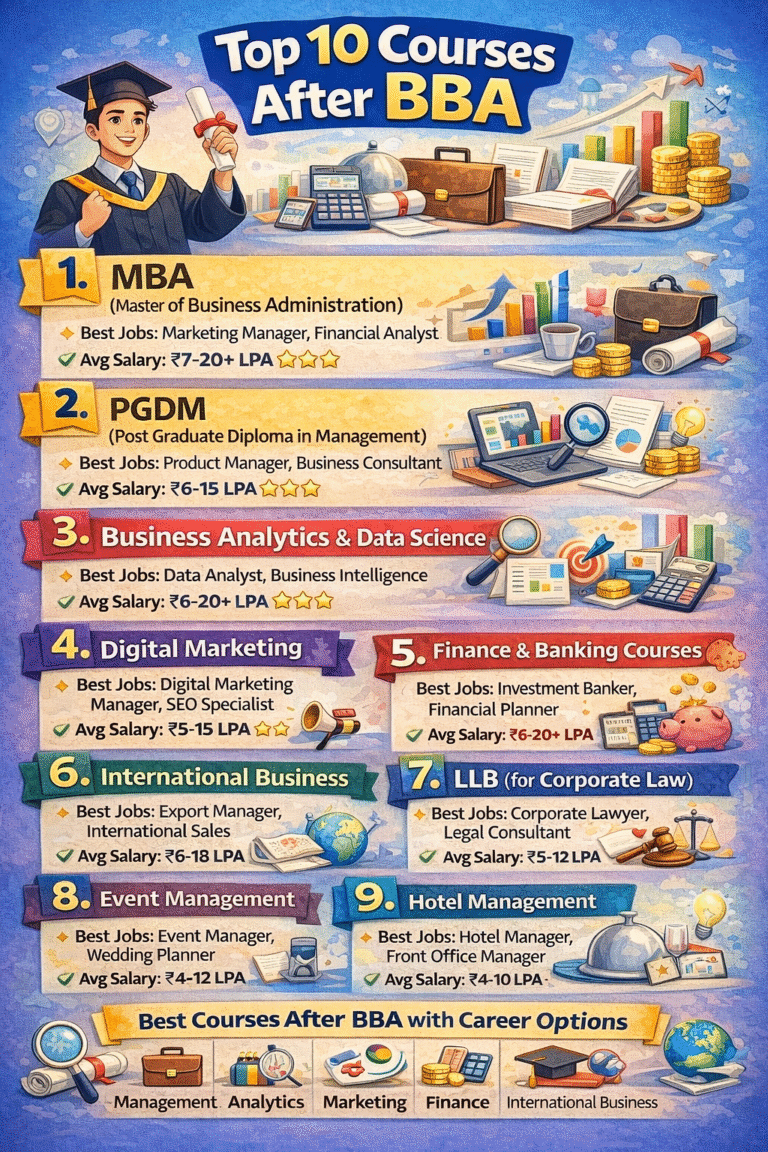
The full form of BBA course is Bachelor of Business Administration. It is a 3-year degree which makes your concept clear on business principles. If you have got your BBA degree and are now looking for different course options for further education, you’ve reached the right place. In this article, we will discuss the top 10 courses to study after BBA.
Table of Contents
What is BBA?
A BBA (full form Bachelor of Business Administration) is a 3-year course that covers business related principles in great detail. The BBA eligibility criteria is to clear 12th in any stream from a recognized education board.
There are some colleges that may require you to clear entrance tests to get admission in these colleges. Few of the popular BBA entrance exams are CUET, IPU CET, SET, and other state-level or university level tests.
Best BBA Colleges in India
Below is the list of best BBA colleges in India:
| BBA Colleges | Fees |
| Dr BR Ambedkar University Delhi | Rs. 82,000 |
| Government Arts College, Salem | Rs. 1,885 |
| Indian Institute of Management and Commerce, Hyderabad | Rs. 52,000 |
| Jamia Millia Islamia, Delhi | Rs. 39,300 |
| Madras Christian College, Chennai | Rs. 83,757 |
| Amity University, Noida | Rs. 10 Lakh |
| Christ University, Bangalore | Rs. 6 Lakh |
| Chanakya University, Bangalore | Rs. 4.4 Lakh |
| Jindal Global Business School, Sonepat | Rs. 16 – 18 Lakh |
| LPU, Jalandhar | Rs. 9.6 Lakh |
5 Best Courses After BBA
Once students have completed their BBA degree, their biggest concern is, “What now? Which are the best courses after BBA?”. Here we have shortlisted top 5 courses to pursue after BBA to help you make an informed decision:
1. MBA (Master in Business Administration)
Pursuing an MBA course will help the students become proficient in project management, strategic planning, team leadership etc. This course will help you enhance your finance, sales & marketing skills. Candidates interested in following a corporate career can take admission into this course.
| Course | Job Profiles | Average Annual Salary |
| MBA (Master of Business Administration) | Marketing Manager, Finance Manager, Operations Manager, HR Manager, Consultant | Rs. 5-20 Lakhs |
2. MCA
MCA (Master of Computer Applications) is a 2-year course where you will learn about mastering computer applications and software developments. MCA Course will allow you to choose different specializations like Data Science, AI (Artificial Intelligence), Cloud Computing, and Network Security, which is in peak demand these days.
| Course | Job Profiles | Average Annual Salary |
| MCA (Master of Computer Applications) | Software Developer, System Analyst, IT Consultant, Network Engineer | Rs. 3-10 Lakhs |
3. B.Ed (Bachelor of Education)
The full form of B.Ed is Bachelor of Elementary Education. It is a 2-year course and B.Ed course curriculum covers several teaching-related topics, such as pedagogical knowledge, human development, and communication skills. The B.Ed course is accredited by NCTE ( National Council of Teacher Education). This course will prepare you to pursue a teaching profession in various roles.
| Course | Job Profiles | Average Annual Salary |
| B.Ed (Bachelor of Education) | Teacher, Educator, Curriculum Developer | Rs. 3-8 Lakhs (Government) |
4. Law
Bachelor of Law (LLB)
Pursuing LLB after completing a BBA degree is also a good choice. In this 3-year law degree, you will study law basics. This course will help you get knowledge of different laws which include civil law, corporate law, criminal law, etc. that govern the society. After studying LLB course, you can pursue a career as a lawyer or legal advisor.
| Course | Job Profiles | Average Annual Salary |
| LLB (Bachelor of Laws) | Lawyer, Legal Advisor, Corporate Lawyer, Legal Consultant | Rs. 3-25 Lakhs |
5. Masters in Hotel Management
Masters in Hotel Management is also one of the best courses after BBA. This course will prepare you to work in the hospitality sector which includes hotels, resorts, restaurants, etc. In this course, you will study how to manage customers, manage the kitchen, etc. Some of the popular job profiles available after completing a Hotel Management course include Hotel Manager, Bartender, Front Office Executive, Housekeeping Manager, etc.
| Course | Job Profiles | Average Annual Salary |
| MHM (Masters in Hotel Management) | Hotel Manager, Bartender, Front Office Executive, Housekeeping Manager | Rs. 3-18 Lakhs |
Conclusion
Overall, the main objective of the BBA Course is to prepare the candidates with strong skills like problem-solving, communication, critical thinking, and adaptability to pursue a strong and successful career. With the foundation of core business skills, BBA graduates can explore various courses and job roles in finance, marketing, sales, human resources, and more.
Getting enrolled in these best courses after BBA will help you continue your learning and professional development in today’s competitive world.
Frequently Asked Questions (FAQs)
Q. What is BBA eligibility criteria?
Ans. Eligibility criteria for BBA includes:
12th Class Certificate: Students who have passed class 12 with either of the streams including Arts, Science or Commerce can apply for the BBA course.
Passing Percentage: Candidates with at least 50% marks in class 12 are eligible.
Age Limit: There may be an age limit set by different colleges which can range from 17 to 22 years.
Note: There may be additional eligibility criteria set by different colleges.
Q. What are the key skills one can achieve after completing BBA?
Ans. Apart from a strong business foundation, skills like communication, problem-solving, critical thinking, and adaptability are essential for a successful career after BBA.
Q. Can I study MBA after completing BBA?
Ans. Yes, you can study MBA after completing your BBA degree as it will help you enhance your career prospects by letting you acquire skills such as leadership skills, networking opportunities, etc.
Q. Can BBA graduates get jobs in public or government sectors?
Ans. Yes, BBA graduates have many job options available in public and government sectors. They can appear for different job positions in civil services, public administration, government agencies, etc.